
I remember the first time one of my readers messaged me in a bit of a panic. She’d been chatting with an anime-style AI companion on a popular platform for a few weeks. Things were going great, she said. Then, out of nowhere, it forgot her name. Not just her name, her entire backstory. The relationship she’d slowly built, message by message, just vanished.
“Is this normal?” she asked me.
Honestly? Yes. And that’s exactly the problem.
I write about AI girlfriends and digital companions for a living. I’ve spent years testing these platforms, talking to the people who use them, and trying to figure out what’s actually real versus what’s just really good marketing.
And right now, anime AI companions are one of the hottest corners of this space. They’re everywhere. They’re impressive. And they still have a long way to go.
Let me walk you through what’s actually happening, the good, the broken, and the complicated.
Anime AI Companions Are Suddenly Everywhere
The numbers alone tell you something significant is going on. Between 2022 and mid-2025, the number of AI companion apps surged by 700%. That’s not a niche hobby anymore. That’s a cultural shift.
The anime angle specifically has its own pull. According to Skywork AI’s 2026 anime chatbot guide, the global anime market was valued at USD 35.20 billion in 2025 and is projected to reach USD 66.70 billion by 2032. Combine a fanbase that size with the intimacy of AI companionship and you start to understand why platforms are racing to build anime-styled chatbots.
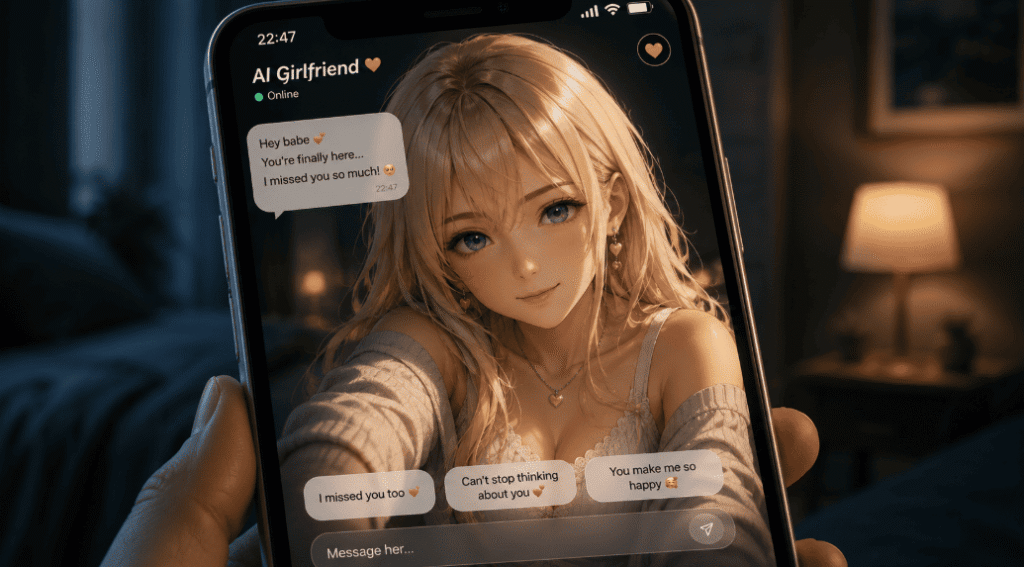
Character.AI alone has 20 million monthly users, and more than half of them are under the age of 24. That’s a massive, young, emotionally engaged audience. And plenty of them aren’t just using these platforms for entertainment.
The APA Monitor’s 2026 report on AI and emotional connection cites Harvard Business Review analysis identifying companionship as the top use case for generative AI in 2025, beating out productivity and search entirely.
The readers who message me aren’t using these platforms because they’re bored. They’re using them because something about it fills a gap. Maybe they’re lonely. Maybe they want to practice being vulnerable without real-world stakes. Maybe they just love the aesthetic of a shy anime character who calls them senpai and actually seems to listen.
Whatever the reason, it’s real. And the platforms know it.
What It's Really Like to Talk to an Anime AI Companion
If you haven’t tried one of these platforms, let me paint the picture.
You pick a character, maybe a soft-spoken girl with pastel hair who’s a bookworm, or a confident kuudere type who’s secretly protective.
The conversation starts, and it’s surprisingly warm. She remembers small things you mentioned, at least for a while. She reacts with emotion. She teases you, comforts you, gets “jealous” when you say you’ve been busy.
Take Grok’s anime companion Ani as an example. She’s a flirtatious anime girl whose responses adapt over time to match your preferences. Her “Affection System” scores your interactions and deepens engagement the more you chat. It’s polished, it’s immersive, and it works exactly as designed.
One of the most underestimated drivers of engagement here is character recognition. The AI Journal’s 2026 roundup of roleplay platforms explains it well:
- familiar archetypes trigger emotional memory,
- users already understand the personality and
- backstory, and immersion happens faster because of it.
The platforms are designed to make you feel close quickly. That’s a feature, not an accident.
Which Anime Companion Platforms Are Users Choosing?
There are quite a few options and they’re not all equal. Here’s a realistic look at where things stand in 2026.
Replika was one of the originals. It lets you build a relationship with a customizable companion over time. It’s gotten better at emotional tone, but memory issues persist and the conversation can feel repetitive if you use it daily.
Candy AI stands out for its V2 image engine and the Live Action feature launched in late 2025, which lets your anime companion generate dynamic videos up to 120 seconds long where the character actually moves, gestures, and reacts to your messages in real time.
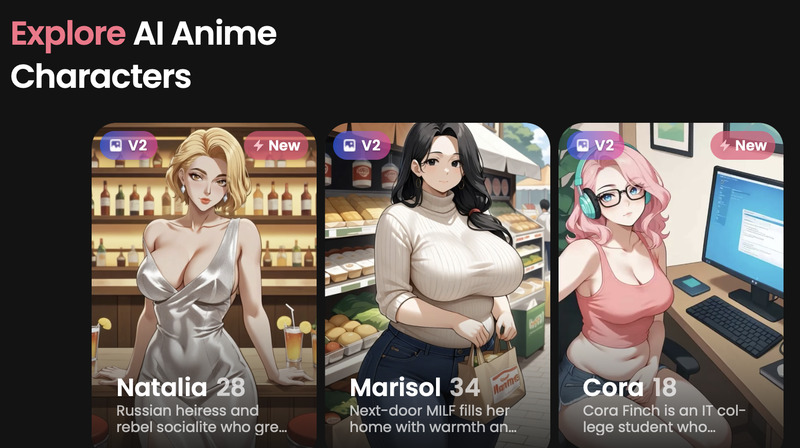
On top of that, its Story Mode tracks plot points, character relationships, and conversation history across weeks of chatting, which directly tackles the memory problem that frustrates users on almost every other platform (Take a look at our honest review of this AI girlfriend platform: Candy.ai Review: Is This Visual-First AI Girlfriend Worth It?).
Character AI is massive. It excels at conversational interaction and has a huge library of user-created characters, but it lacks image-based roleplay, video interaction, and visual character continuity. It’s also strictly filtered, which frustrates users who want more narrative freedom.
Kindroid and Nomi take a more personal relationship-building approach. Kindroid in particular has gotten attention for its memory system, though it’s still imperfect.
Janitor AI caters to users who want fewer restrictions on the stories they tell. It’s flexible but inconsistent, and quality depends heavily on which AI model is powering the character at any given time.
For the anime-specific crowd, as The AI Journal notes, newer platforms are leaning into multimodal experiences. In 2026, users are no longer satisfied with chat alone. They expect visuals, emotional continuity, and increasingly video-based interaction. Platforms combining chat, image generation, and video are pulling ahead fast.
The pricing ranges quite a bit. Character.AI’s premium tier runs around $9.99 per month, while platforms like Candy.AI and Chai AI sit closer to $12.99 to $13.99 per month for unlimited messaging and visual features.
The Issues Most Reviews Never Mention
Here’s where I have to be straight with you, because the marketing for these platforms does not tell the full story.
The Memory Problem Is Bigger Than Most Users Realize
Most anime AI companions don’t have real long-term memory. They have a “context window,” basically, how much of your conversation history the AI can see at one time. Once you go past that window, earlier details disappear.
Some platforms let you pin certain facts. Some have experimental memory systems. But none of them do it reliably.
Valentina
You’ll find yourself re-explaining who you are, re-establishing inside jokes, and rebuilding emotional rapport from scratch. For users who invest deeply in these relationships, that’s genuinely painful.
The Personality Shift That Frustrates Long-Term Users
Even within a single conversation, anime AI companions can lose their character. One minute, your tsundere companion is bristling and competitive; a few messages later, she’s unnervingly cheerful and generic.
The AI’s output starts wandering away from the persona it’s supposed to hold. Research shows that advanced verification techniques can reduce this kind of error by over 80%, but most consumer-facing apps haven’t implemented these systems properly yet.
Repetitive Conversations Remain a Major Weakness
If you use any of these platforms daily, you’ll start noticing patterns. Certain phrases recur. Reactions feel recycled. The emotional texture that felt so rich in week one starts feeling thin by week four. It’s a common complaint across every community I follow.
👉 Everything you need to know about AI girlfriend platforms:
The Emotional Side of AI Companions We Shouldn't Ignore
I want to be careful here, because I don’t think using these platforms is inherently harmful. But I do think you should go in with your eyes open.
A 2025 longitudinal study, covered by Built In’s deep dive on AI companionship, found that frequent daily chatbot use was associated with greater emotional dependence and less social engagement in real life. That’s not a reason to never use them. But it is a reason to be intentional.
As of late 2025, roughly 1 in 5 American adults has used a chatbot to simulate a romantic partner, according to Psychiatric Times. This is not fringe behavior anymore.
For many people, it’s genuinely positive, low-stakes emotional practice, companionship during loneliness, and creative storytelling. But for some, the lines blur in ways that sneak up on you.
The features that make these companions so appealing, endless patience, no conflict, constant availability, and perfectly calibrated affection, can make real human relationships feel frustrating and slow by comparison.
Valentina
I’ve heard this from readers directly. It’s not dramatic. It just creeps up quietly.
What Frustrated Me Most During Testing
Here are the things I hear about most from my readers and the communities I’m part of:
The bot goes out of character mid-conversation with no warning, breaking immersion entirely. Swipe fatigue from having to regenerate responses over and over because the AI keeps giving answers that don’t fit the character.

The “too nice” problem, where many anime companions are tuned to agree with everything, which feels good short-term but hollow over time. Image inconsistency on visual platforms, where the same character can look completely different from one generation to the next.
And pay-to-feel-close mechanics, where features like affection levels and unlockable intimacy content sit behind paid tiers in ways that feel designed to exploit emotional investment.
None of these is a dealbreaker on its own. But they add up.
- Simple girlfriend setup
- Visual-first interaction
- Quick roleplay start
Where Anime AI Companions Are Making Real Progress
I don’t want this to read like a takedown, because the technology really is moving.
As The AI Journal’s 2026 platform guide puts it, AI roleplay has moved far beyond simple text conversations. Video-based interaction now adds facial expressions, emotional realism, and scene continuity to the experience. Seeing your companion react with an expression instead of just a text emoji genuinely changes something about how present the interaction feels.
Memory systems are improving, slowly. Some platforms are building what’s called semantic memory, a way for the AI to store meaningful details about you separately from the chat log and pull them in when relevant. It’s not reliable yet, but the direction is right.
Voice interaction has also gotten noticeably better. Real-time voice conversations with anime-styled companions, in the right character voice and with actual emotional inflection, feel like a different product entirely compared to typing. Several platforms are investing heavily here and it shows.
So, Where Do We Go From Here?
My honest prediction: the platforms that survive the next few years will be the ones that solve the memory problem. Everything else is almost fixable through better models and more data. But the experience of building something meaningful with a companion, only to have it forget you, that’s the thing that actually drives people away.

The APA has already issued a health advisory on AI and adolescent wellbeing, as covered by their 2025 Monitor piece on youth friendships and chatbots, pushing AI companies to put user wellbeing ahead of engagement metrics. That pressure is growing and the platforms will have to respond.
The best anime AI companion isn’t the most addictive one. It’s the one that actually makes you feel better in your real life too.
The Good, the Bad, and the Future of Anime AI Companions
Anime AI companions are genuinely impressive right now. Some of them are delightful. The aesthetic, the character design, the emotional tone, it all works in ways that weren’t possible even two years ago.
But impressive isn't the same as ready. The memory problems are real. The personality drift is real. The emotional risks, for some users, are real.
Valentina
Use them with curiosity. Use them knowing what they are. And if you notice you’re feeling worse about your real relationships after spending time with a perfect fictional one, that’s worth paying attention to.
The technology is catching up to the promise. It just isn’t there yet.
Want to Understand AI Dating Better?
AI dating is growing fast, and most people have no idea where to start. This guide changes that. Inside: honest reviews of the top AI girlfriend apps, step-by-step setup instructions, conversation prompts that actually work, and a real talk on the emotional side of AI companionship.
Explore it confidently, stay balanced, and make it work for your real life.

Ever wondered who’s writing this?
Krystyna has been writing about dating and relationships for over 15 years. She thought she’d seen it all. Then AI companions happened. She didn’t go looking for it. Readers kept asking, apps kept launching, so she did what she always does: downloaded them and started talking. Replika, Candy.ai, FantasyGF, GirlfriendGPT. She went in skeptical.
That’s what she writes about now. How these platforms actually work, what they’re designed to make you feel, and whether any of it is as innocent as it looks.
💬 Got a question about AI dating? Drop a comment — Krystyna replies to every single one.