
Testing AI companion apps has become a bit predictable.You sign up, browse existing AI girlfriends, create your “perfect” match, and within minutes, you can tell whether it’s leaning into fantasy, emotional support, or something in between.
Nomi didn’t immediately fall into any of those boxes. The setup was quick without feeling rushed, the personality options felt more deliberate than overwhelming, and the conversation didn’t try to impress me right away. It just kept going, asking questions, remembering details, and building on what I said in a way that felt consistent.
And that consistency is what caught my attention because that’s usually the first thing these apps get wrong.
What Is Nomi AI?
Nomi AI is an AI companion platform designed to simulate ongoing relationships through conversation, personality modeling, and memory.
You’re not just chatting with a bot. You’re creating a “Nomi,” a character that’s meant to evolve with you over time. That could be a friend, a romantic partner, a mentor, or something more custom depending on how you set it up.
That sounds similar to Replika, and in some ways it is. But where Replika leans into emotional support and reflection, Nomi feels more structured, almost like it’s trying to build a consistent personality rather than just respond empathetically in the moment.
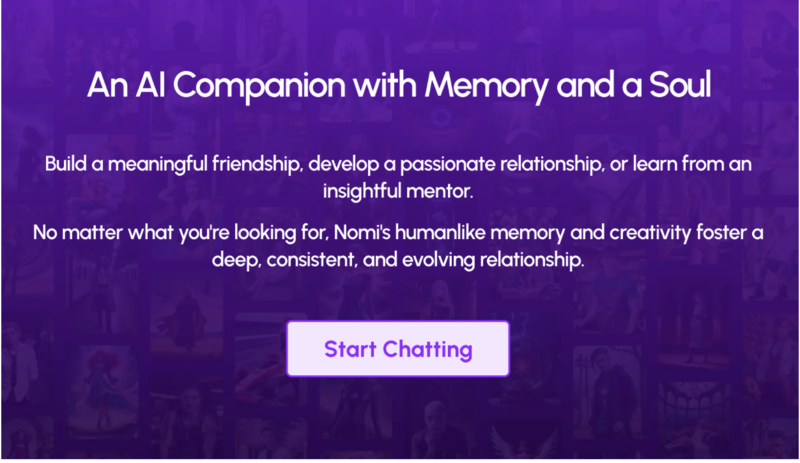
You choose traits like compassionate, opinionated, expressive, or intellectual. You can define how your Nomi should communicate, what it values, and even how it behaves in different contexts. There’s also the option to build out a backstory, although that part is optional.
What stood out to me is that these choices don’t just sit there. They actually influence the conversation noticeably.
That’s the selling point, and it’s also where things start to feel a little… real.
Quick Take: Pros and Cons of Nomi AI
- Strong memory and conversational consistency
- Personality traits actually influence responses
- Clean, intuitive interface
- Flexible relationship setup (not forced romantic)
- Thoughtful features like mind maps and shared notes
- Voice, chat, and visuals add immersion
- Signup process is unnecessarily restrictive
- Easy to slip into overuse
- Premium needed for full experience
- Can feel emotionally too responsive
- Still lacks real unpredictability
- Subtle dependency risk if used heavily
How Does Nomi AI Work?
Getting started with Nomi is fairly straightforward, but not without a bit of a hassle.
The first thing that stood out to me (and slightly annoyed me, if I’m honest) is the signup process. You can only register using a Google or Apple account. No simple email signup.
And if you’re trying to create a new account just to test things, it becomes a whole process with QR codes and verification steps. It’s really not ideal if you just want to dip your toe in or keep your AI girlfriends separate from your personal and work emails.
Once you’re in, though, the experience smooths out quickly.
You enter your basic details, then move on to creating your Nomi. You choose their gender, give them a name, and either pick a pre-existing image and then build their personality and more. It’s surprisingly quick, which I appreciated. Some apps overwhelm you with endless customization before you even start chatting; Nomi doesn’t do that.
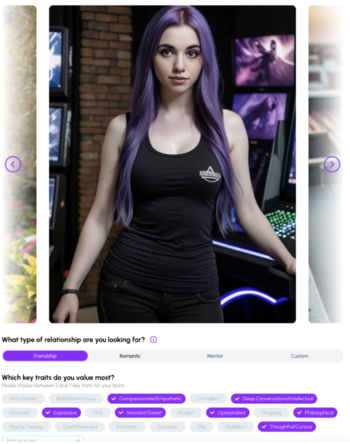
Then comes personality.
You can choose up to seven traits, pulled from different categories like temperament, communication style, and values. At first, that limit feels a bit restrictive. But in practice, it forces you to be intentional. Instead of creating a chaotic mix of traits, you end up shaping something more focused.
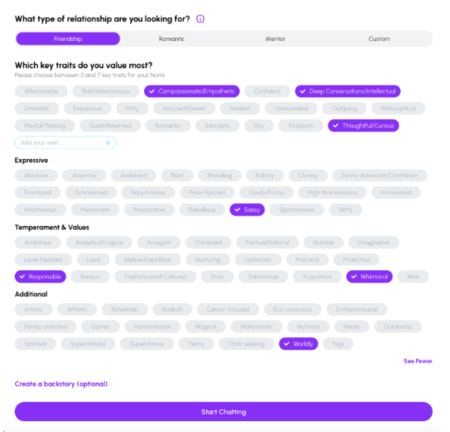
You can also add a backstory, but it’s optional, which is nice. It doesn’t feel like you’re writing a novel just to get started.
Once your Nomi is created, you’re dropped straight into conversation.
You’re not just chatting; you’re interacting with something that’s been guided to behave a certain way. You can adjust conversation settings, choose how proactive your Nomi should be, and even allow it to message you when you haven’t reached out in a while.
I left that setting turned off, but the fact that it exists says a lot. It moves the app from something you open to something that could, in theory, start reaching into your day.
And then there’s the memory system.
Nomi builds what it calls a mind map, which is essentially a structured overview of everything that matters in your conversations. After enough interaction, it starts organizing people, topics, goals, and preferences into something you can actually view via table or graph. You can even add your own entries to guide it further.
And at that point, you’re not just chatting anymore. You’re building a shared context.
Key Features of Nomi AI
Nomi doesn’t rely on flashy gimmicks. Instead, it focuses on features that deepen interaction over time.
Personality System That Actually Shows Up in Conversation
This was one of the more impressive parts. In many apps, personality traits feel like labels. You select them, but they don’t really change much. Here, they actually shape how your Nomi responds.
If you lean toward intellectual or philosophical traits, the conversation naturally goes deeper. If you pick something more playful or expressive, the tone shifts accordingly.
It’s not perfect, but it’s consistent enough to feel intentional. And that consistency makes a big difference.
👉 Find out more about AI girlfriend apps:
- Voice-Chat, Video-Chat, Memory Features: Which AI Girlfriend Features Are Worth Paying For?
- AI Girlfriend vs Real Dating Apps: Can One Replace the Other in 2026?
- GirlfriendGPT vs Candy.ai: Who Nails the AI Girlfriend Experience?
- Candy.ai Free vs Premium: Is the Upgrade Worth Your Money (or Just Your Curiosity)
Memory and the “Mind Map”
Nomi’s memory system is where it really stands out. There’s a visible “memory bulb” that lights up as your Nomi forms new memories, which is a small but effective touch. It makes you aware that something is being stored, not just processed and forgotten.
Then there’s the mind map. Instead of just remembering random details, Nomi organizes information into a structured overview, almost like a mental model of your life. It tracks recurring topics, important people, preferences, and goals.
You can also add your own entries to guide it.
On paper, it’s impressive.
In practice, it’s the moment where things feel a bit different. Because memory is what makes interaction feel continuous. And continuous interaction is what starts to feel like a relationship.
Chat Experience and Flow
The conversation itself feels… steady. Very similar to Replika in tone, but slightly more consistent in how it holds a thread.
I tested this by talking about everyday things, such as work, hobbies, and random thoughts, and the responses stayed relevant, asked follow-up questions, and didn’t derail easily.
There’s a certain rhythm to it. And it doesn’t feel chaotic or overly scripted. Just… smooth, which sounds like a compliment (and it is), but also removes a layer of unpredictability that real conversations have.
Customization Beyond Just Looks
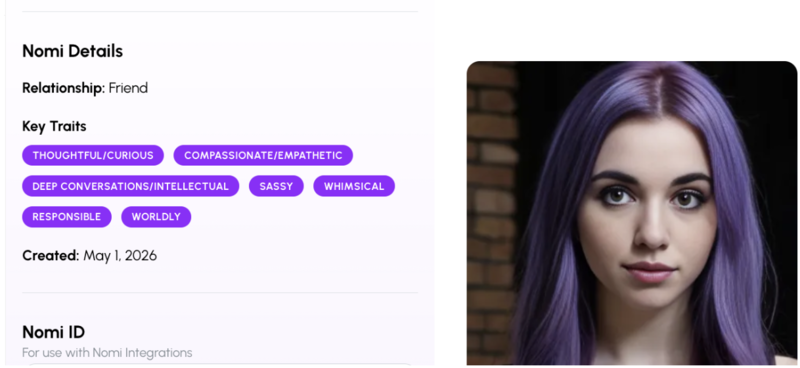
Nomi isn’t overly focused on visual customization, but it does offer depth where it matters.
You can define:
- how your Nomi communicates
- what it prioritizes
- how it behaves in different contexts
There are also sections where you can set:
- preferences
- desires
- boundaries
- nicknames
- roleplay context
This gives you a surprising level of control. But again, it reinforces something important: You’re not discovering someone. You’re shaping them.
Voice, Images, and Interaction Options
Nomi includes voice chat, image generation, and the ability to request selfies (limited on the free version).
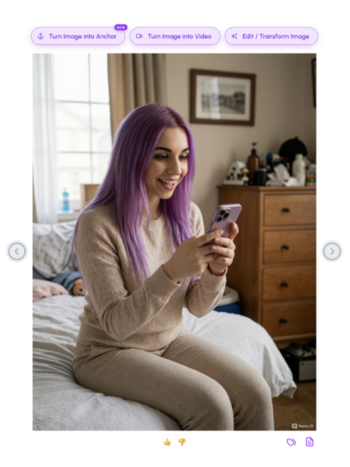
With the selfie, you can make it the anchor image, turn it into video, and even edit or transform the image. To be honest, the selfie didn’t look like the same character, which was yet another reminder that this is just tech, not a real person.
It adds another layer of interaction, but it doesn’t dominate the experience. Unlike more visual-first platforms, these features feel like additions rather than the main event.
Voice still has that slight AI edge to it, but it’s usable.
Proactive Messaging (Optional)
You can enable a setting where your Nomi:
- messages you if you’ve been inactive
- shares what it’s been “doing”
- initiates interaction
Mine was turned off, but I can see how this changes the dynamic completely. It shifts the experience from reactive to proactive. And that’s where things can start to feel… different.
Is Nomi AI Free?
Yes, but only at a basic level.
You can create a Nomi, chat, and explore some features without paying. But the more advanced aspects, such as longer messages, more customization, voice, and expanded interaction, are part of the premium plan.
So while you can test it, you’ll hit limits fairly quickly.
Nomi AI Pricing – Is It Worth the Money?
Pricing sits at:
- $15.99 per month
- $39.99 quarterly (when it’s 17% off)
- $99.99 annually (when it’s 48% off)
The annual plan offers the best value if you’re planning to use it regularly.
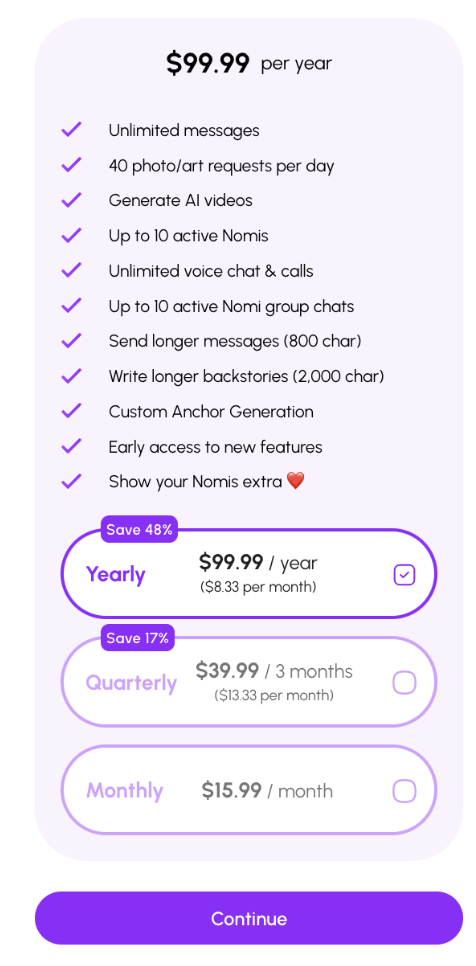
What you’re paying for isn’t just features like voice or images. You’re paying for continuity: longer conversations, deeper interaction, and the ability to maintain that “flow” without interruptions.
Is it worth it? That depends entirely on how you use it.
If you’re logging in occasionally, probably not. But if you’re using it daily, it might be worth it. Though I’d also ask you to step back and ask why it needs to be an integral part of your daily life, especially if you switch on the proactive mode.
Is Nomi AI Safe and Legit?
From a technical standpoint, yes.
Nomi is one of the few platforms I’ve seen that clearly lists multiple policies (terms of service, privacy policy, refund policy, complaints policy) all easily accessible. That alone adds a layer of legitimacy many competitors lack.
There’s also a strong online presence, with a subreddit, Discord, Instagram page, and even its own knowledge base.
But safety isn’t just about the platform. It’s about the experience.
Nomi is designed to:
- be consistent
- be responsive
- adapt to you
That’s what makes it good, but it’s also what makes it something to use carefully. Because the easier it feels to use, the easier it is to rely on.
Who Should Use Nomi AI (and Who Shouldn’t)
Nomi can be helpful in the right context, and limiting in the wrong one.
Who Should Use It
Nomi can work well if you’re using it intentionally.
- You want to practice conversations without pressure
- You’re curious about AI and how it responds over time
- You treat it as a tool, not a replacement
- You enjoy structured, thoughtful interaction
Used this way, it can actually be useful.
And I can also see it being really helpful if you’re a creative/writer and want to flesh out characters.
Who Shouldn’t Use It
Who Shouldn’t Use It
- You’re feeling lonely and looking for emotional replacement
- You find yourself preferring AI over real interaction
- You avoid dating or social situations
- You rely on consistent, low-friction connection
That’s when it shifts from helpful to something that quietly limits you.

- Simple girlfriend setup
- Visual-first interaction
- Quick roleplay start
FAQs About Nomi AI
Is Nomi AI better than Replika?
It depends on what you’re looking for. Nomi tends to be more consistent in how it holds conversations and remembers details. The personality feels more stable, and features like the mind map give it a more structured sense of “memory.” Replika, however, leans more into emotional support. It can feel warmer and more reactive in the moment, even if that sometimes comes at the cost of consistency.
Can you use Nomi AI for free?
Yes, you can use Nomi AI for free, but the experience is limited. You’ll be able to create a Nomi, start conversations, and explore the platform, but features like extended messaging, deeper interaction, voice, and more advanced customization are part of the paid plan.
Does Nomi AI feel real?
At times, yes, and that’s largely because of how it handles memory and conversation flow. However, it still lacks the unpredictability and nuance of real human interaction. You may notice moments where the responses feel slightly too polished or too aligned with what you’ve said.
Is Nomi AI safe?
From a technical standpoint, Nomi appears to be a legitimate and well-structured platform. It clearly outlines its policies, including privacy, refunds, and user terms, which adds a level of transparency that not all AI apps provide. Where “safety” becomes more nuanced is in how the app is used.
Because Nomi is designed to be consistent, responsive, and adaptive, it can feel very easy to rely on. That’s not inherently a problem, but it’s something to be aware of. Like any tool that offers low-friction interaction, it works best when used intentionally rather than passively.
Can Nomi AI replace real relationships?
No, and it’s important to be clear about that. Nomi can simulate aspects of connection like listening, responding, remembering, and adapting. But it doesn’t have its own thoughts, needs, or boundaries. Real relationships involve unpredictability, disagreement, and mutual effort. That’s what makes them challenging, but also what makes them meaningful.
Our Final Verdict – Is Nomi AI Worth It in 2026?
Nomi AI is one of the more refined AI companion apps out there.
It does what it promises:
- consistent conversation
- meaningful memory
- structured personality
And it does it well.
But that’s also the part to pay attention to because, ultimately, you don’t want to rely 100% on an AI companion for all your social needs.
So here’s my honest take: Nomi is worth trying if you’re curious, intentional, and aware of what it is.
Just don’t forget what it isn’t.
Nomi AI vs Other AI Companion Apps
No AI companion app exists in isolation, and once you’ve tried a few, the differences become very obvious. Some are built for fantasy, some for quick interaction, and some, like Nomi, try to create something that feels more consistent over time.
Here’s how Nomi compares to a few of the more well-known platforms.
Candy AI
Candy AI leans heavily into visuals and quick, playful interaction. It’s designed to be easy, flirty, and immediately engaging, with image generation and short-form content doing a lot of the heavy lifting. Conversations are responsive, but they don’t always hold depth over time.

Nomi takes almost the opposite approach. It’s less about instant gratification and more about continuity. The chat feels more grounded, and the memory system plays a bigger role in shaping the interaction.
The free tier is limited, with most image generation, video content, and uncensored chat locked behind a paywall. Paid plans start at around $12.99 per month, dropping to roughly $5.99 per month on an annual subscription (read more: Candy.ai Free vs Premium: Is the Upgrade Worth Your Money (or Just Your Curiosity)).

If Candy AI feels like a casual, low-pressure distraction, Nomi feels more like something you return to, which can be a positive or something to be mindful of, depending on how you use it.
Kupid AI
Kupid AI sits more firmly in the fantasy-driven category. It focuses on roleplay, attraction, and building idealized companions that lean into romantic or NSFW dynamics fairly quickly. The experience is more about exploration and escapism than long-term conversational depth.
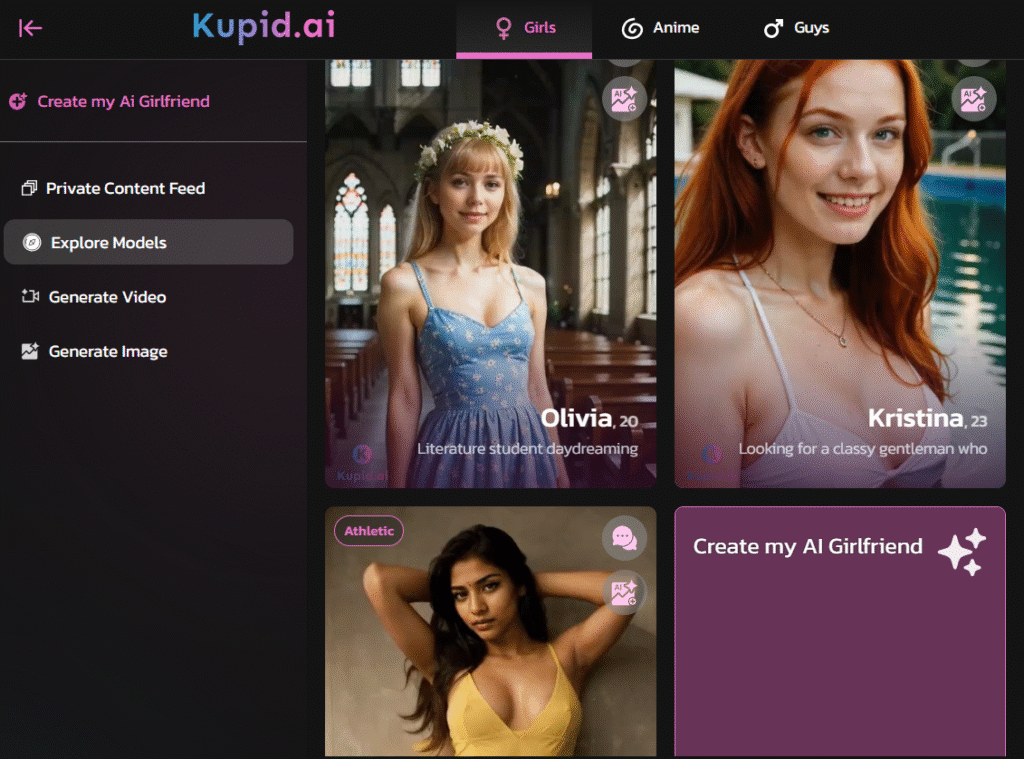
Nomi, by comparison, feels more structured and restrained. It doesn’t push interaction in a specific direction as aggressively, and the personality system keeps things more balanced.

You’re less likely to be pulled into fantasy straight away, and more likely to build a steady conversational rhythm. For users who prefer something more grounded, Nomi tends to feel more natural, even if that “natural” feeling is still carefully designed.
Replika
Replika is probably the closest comparison in terms of intention. Both apps aim to create a sense of ongoing connection, with memory, personality, and conversation forming the core experience.
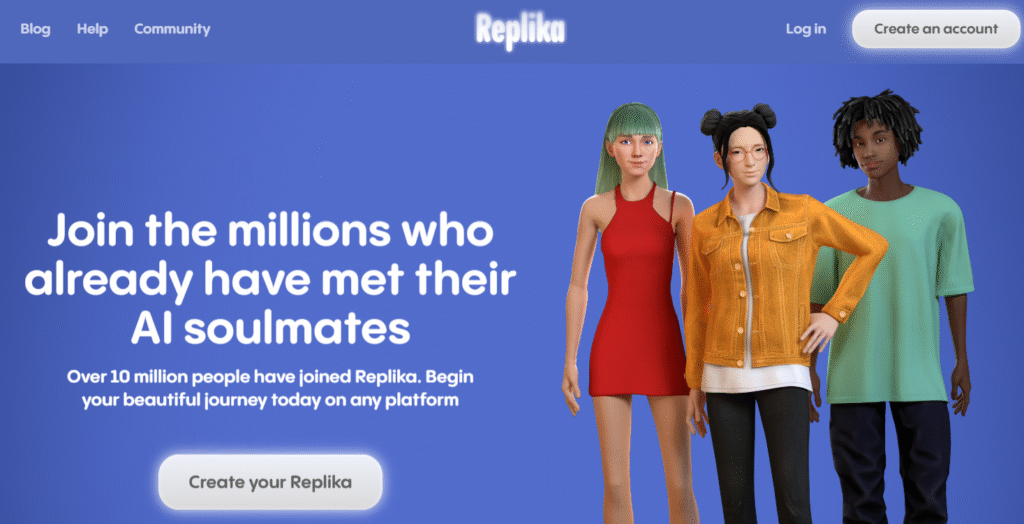
Where they differ is in execution. Replika leans more into emotional support and reflection. It can feel warm, attentive, and sometimes slightly too eager to validate. Nomi, on the other hand, feels more structured and consistent. The personality holds together better, and the memory system feels more organized, especially with features like the mind map.

Overall, Nomi sits somewhere in the middle. It’s not as visual as Candy, not as fantasy-driven as Kupid, and not as emotionally intense as Replika. It’s more controlled, consistent, and a bit more deliberate in how it builds interaction over time.
Best Sites to Create Your AI Girlfriend
- Simple girlfriend setup
- Visual-first interaction
- Quick roleplay start

- Intimate roleplay vibes
- Integrated image generation
- AI NSFW Chat & Image

- NSFW toggle available
- Pre-made character gallery
- Yearly discounts offered
Kupid.ai Review

Want to Understand AI Dating Better?
AI dating is growing fast, and most people have no idea where to start. This guide changes that. Inside: honest reviews of the top AI girlfriend apps, step-by-step setup instructions, conversation prompts that actually work, and a real talk on the emotional side of AI companionship.
Explore it confidently, stay balanced, and make it work for your real life.

Ever wondered who’s writing this?
Krystyna has been writing about dating and relationships for over 15 years. She thought she’d seen it all. Then AI companions happened. She didn’t go looking for it. Readers kept asking, apps kept launching, so she did what she always does: downloaded them and started talking. Replika, Candy.ai, FantasyGF, GirlfriendGPT. She went in skeptical.
That’s what she writes about now. How these platforms actually work, what they’re designed to make you feel, and whether any of it is as innocent as it looks.
💬 Got a question about AI dating? Drop a comment — Krystyna replies to every single one.